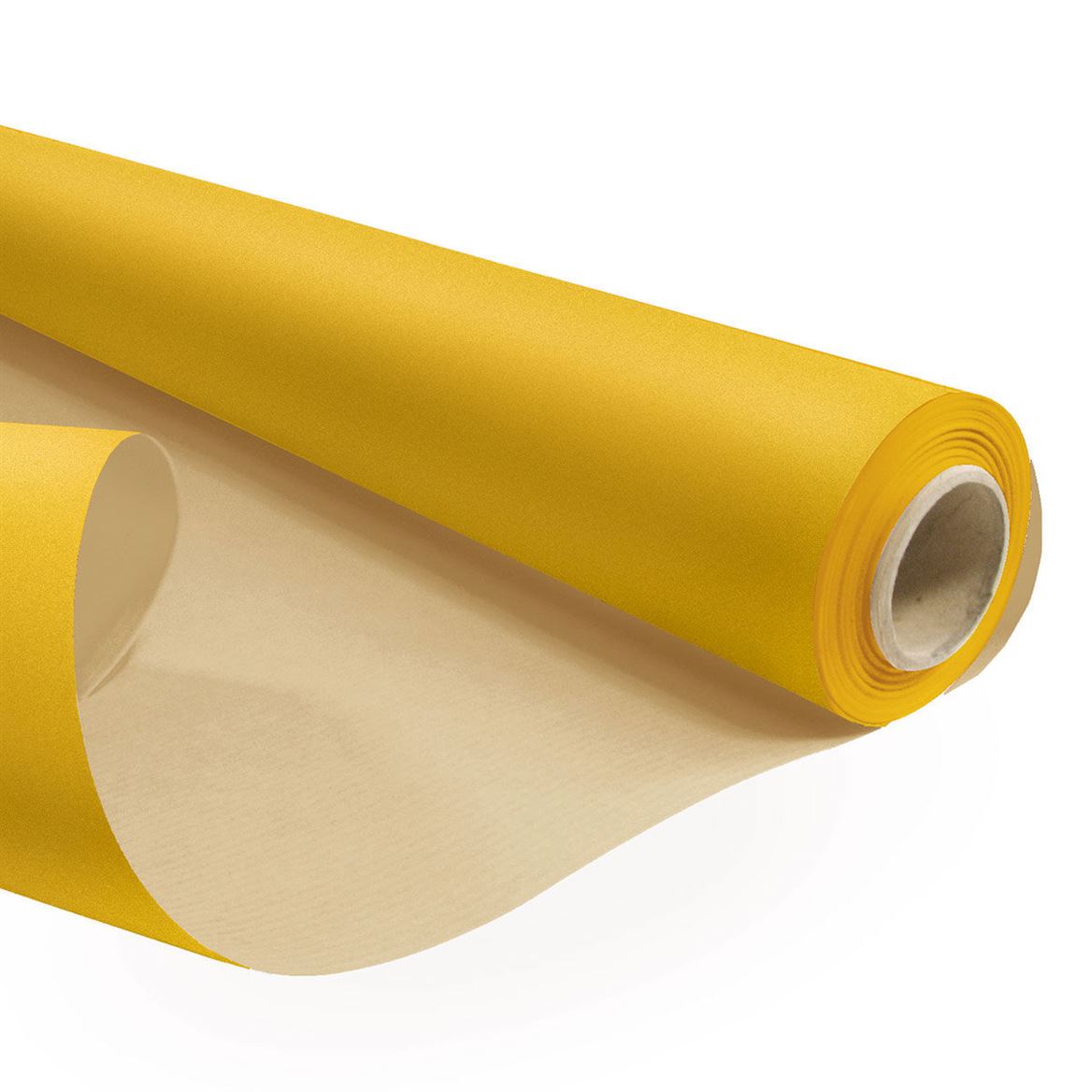
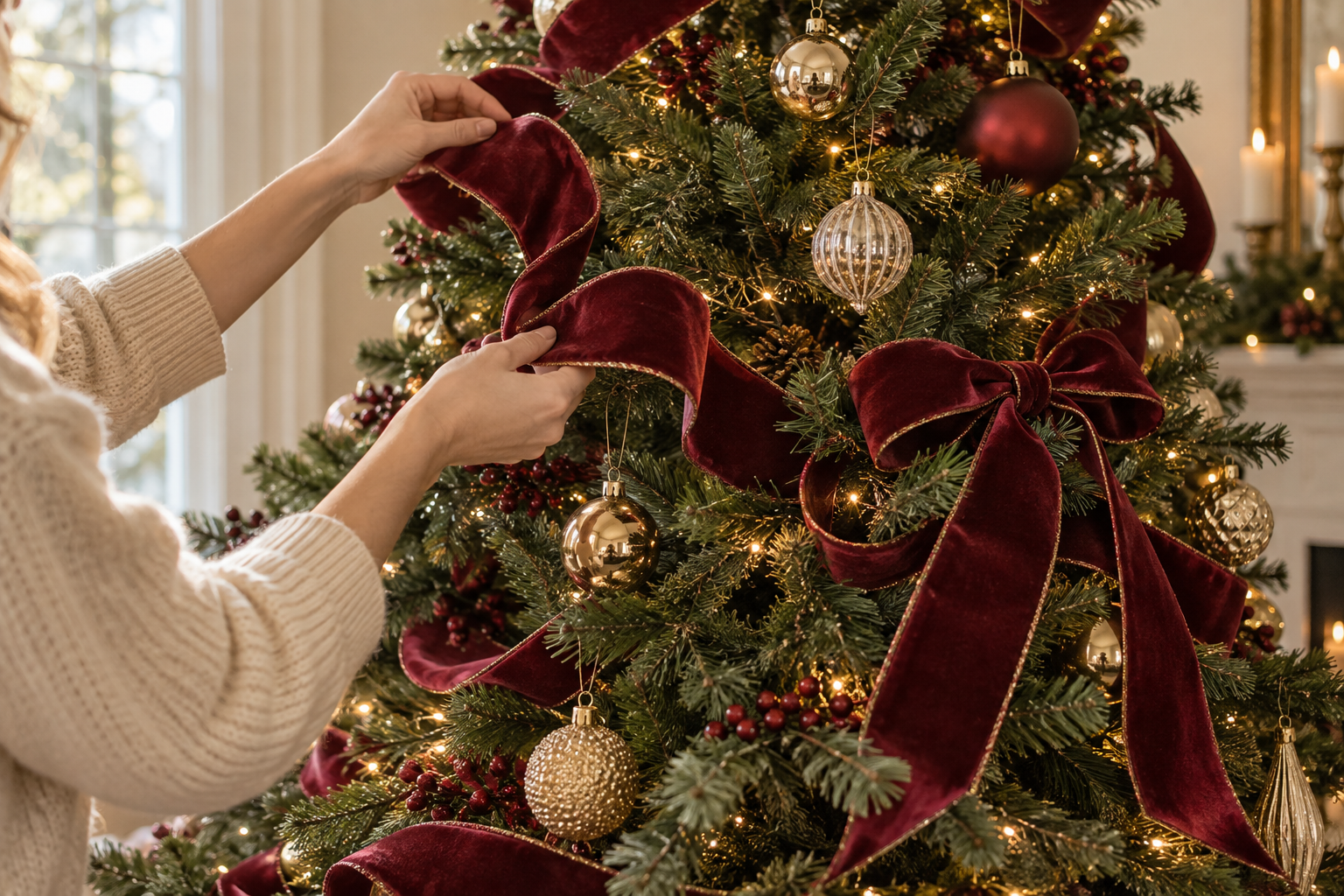
Ribbon can transform a Christmas tree without requiring an excessive number of decorations. It can connect different colours, follow the shape of the branches and introduce movement between baubles, lights and botanicals.
The result depends on how the ribbon is selected and arranged. A ribbon that is too soft may disappear into the branches, while a highly structured ribbon can make the tree look rigid if it is used without visual pauses. Begin by deciding what role the ribbon should perform.
What effect do you want to create?
Ribbon can be used in four main ways:
- as a vertical cascade that emphasises the tree’s height;
- as a diagonal movement that guides the eye;
- as a series of bows creating focal points;
- as a visual connection between groups of baubles, branches and decorations.
You do not need to combine all four techniques. One approach may be enough for a small tree. A larger display can alternate waves and bows while maintaining a clear direction.
How to choose Christmas ribbon
Wired or soft ribbon?
Ribbon with a shapeable edge is useful for waves, dimensional bows and forms that need to remain visible. The edge allows each loop to be opened and adjusted after installation.
Soft ribbon produces a more natural fall. It suits loose tails, simple knots, gift wrapping and compositions in which the fabric should drape freely.
Before selecting a ribbon, create a test loop and check whether the material maintains the intended shape.
Width and proportion
Wide ribbon has greater visual presence and can become a leading element. Narrow ribbon works better for details, ties and contrasting accents.
A single narrow ribbon may disappear on a large tree, while a very wide ribbon may cover too much of a small one. One practical solution is to combine a main ribbon with a narrower secondary design, keeping the number of colours and finishes controlled.
Surface and light
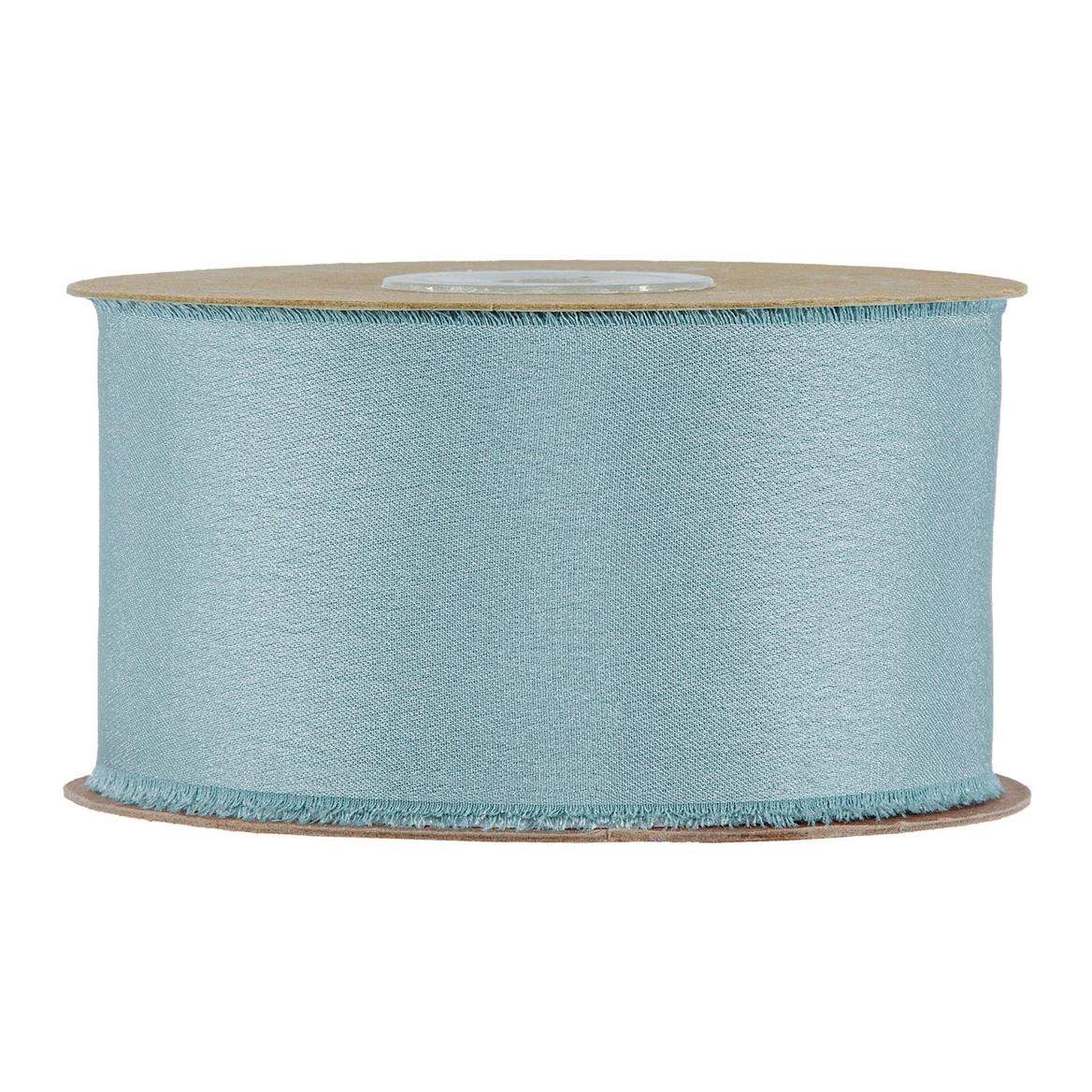
Velvet and matte textiles create depth. Organza and transparent materials allow light to pass through, while satin and metallic edges produce more defined reflections.
Choose one leading material and one supporting finish. If the tree already contains many glossy ornaments, a matte ribbon can create balance. If the composition is natural and understated, a subtle metallic edge can introduce light without changing the overall style.
Explore the MyFlower ribbon selection to compare colours, widths and finishes.
How to coordinate colours
Repeat one colour already present in the decorations and introduce a second ribbon only when it has a clear role.
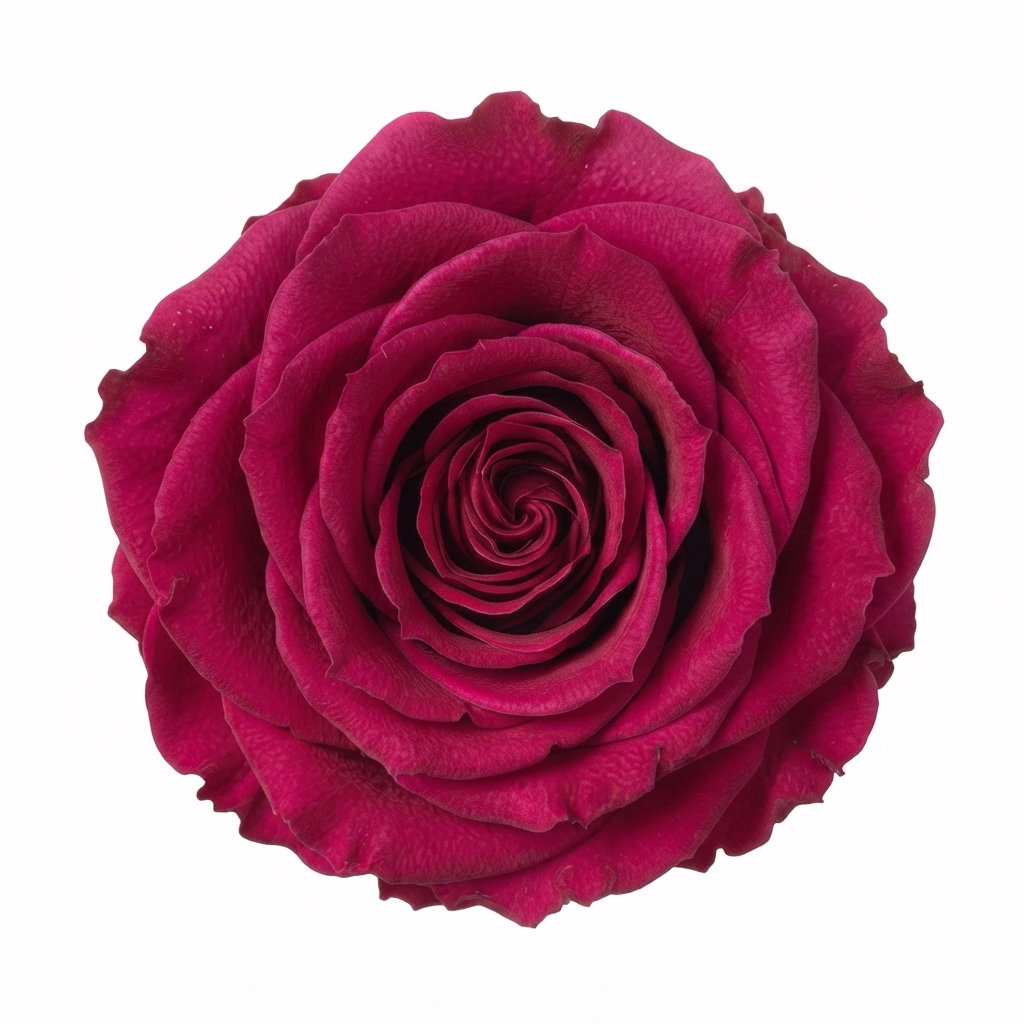
- burgundy and cream for a soft, elegant atmosphere;
- deep green and gold for a classic effect;
- silver and misty pastels for a luminous composition;
- copper and red for a more expressive scheme;
- neutral textiles and botanicals for a natural style.
The colours do not need to appear in equal quantities. One can dominate while the other is limited to bows or selected highlights.
For a burgundy and cream palette, combine the burgundy Chic Velvet Ribbon with the cream Chic Velvet Ribbon, choosing one as the main colour and using the other as an accent.
Four ways to arrange ribbon
1. Vertical cascades
Imagine the tree divided into vertical sections. Begin near the top and guide the ribbon downwards, tucking it into the branches at irregular intervals.
Avoid pulling it into a perfectly straight line. Create gentle curves and allow some sections to project further than others. Vertical cascades emphasise height and can work well on relatively narrow trees.
2. Diagonal movement
Guide the ribbon along a soft spiral without wrapping every level of the tree.
Alternate visible sections with portions tucked into the branches. The eye should be able to follow the direction, but the ribbon should not resemble one continuous band. This technique is effective when connecting groups of baubles or repeated colours.
3. Distributed bows
Prepare a limited number of bows and use them as focal points. Vary their size and orientation slightly while keeping the material and palette consistent.
A larger bow can sit near the top or in an asymmetrical position. Smaller bows can repeat its movement elsewhere. Step back and inspect the tree before fixing them permanently.
4. Ribbon with branches and botanicals
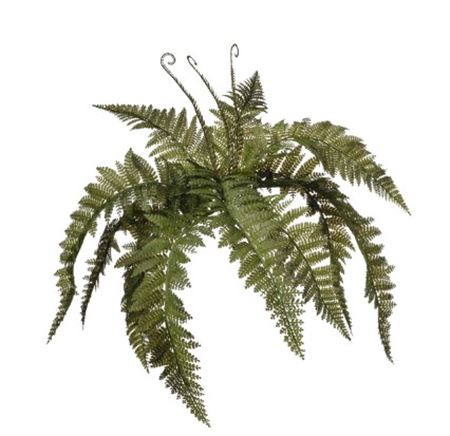
Ribbon can emerge from groups of branches, leaves, artificial flowers and baubles. Here it does not need to create a continuous route; its purpose is to connect the individual groups visually.
This approach is particularly suitable for entrances, shop windows, events and statement trees.
The right order of work
- assemble and open all the branches;
- install and test the lights;
- add the largest structural elements;
- arrange the ribbon;
- place medium-sized baubles and decorations;
- complete the design with smaller details;
- inspect the tree from the front and sides.
Adding ribbon before most of the ornaments makes it easier to shape it between the branches. Individual sections can still be adjusted at the end.
For larger focal decorations, see the guide to oversized velvet baubles.
How much ribbon do you need?
There is no universal quantity. The amount depends on the technique, ribbon width, depth of the waves and number of bows.
The most reliable method is to create a test section:
- complete one cascade or bow;
- measure the ribbon used;
- decide how many times the element will be repeated;
- add an allowance for cuts, tails and adjustments.
This bases the estimate on the actual design rather than the height of the tree alone.
Mistakes to avoid
- pulling ribbon too tightly around the branches;
- distributing identical bows at perfectly even intervals;
- combining too many competing finishes;
- hiding all the ribbon beneath the baubles;
- cutting every section before testing one;
- decorating only the front when the sides are visible;
- leaving wires or fixing materials exposed.
How to store ribbon
Remove each section without pulling the fabric. Open bows, undo knots where possible and wind the ribbon around a sufficiently wide support.
Avoid sharp creases, heavy items placed on top and damp storage conditions. Keep delicate ribbon, velvet and shapeable edges separated.
Frequently asked questions
Can I use two different ribbons on the same tree?
Yes. Give them a clear relationship: the same colour with different finishes, or similar materials in two coordinated colours.
Does ribbon need to reach the base?
Not necessarily. It can stop earlier and leave space for ornaments, gifts and botanicals. Visual continuity matters more than uninterrupted length.
Are waves or bows better for a small tree?
Short, gentle waves use less visual space. If you choose bows, keep them limited and proportional to the tree.
Can Christmas ribbon be reused?
Yes, when it is removed and stored carefully. A neutral main ribbon can be reinterpreted in later seasons by changing the secondary colour and decorations.
Complete the project with the MyFlower Christmas selection.
For shops, hotels, restaurants, weddings and events: discover My Flower Pro and develop a display suited to the space, circulation and visual identity.