





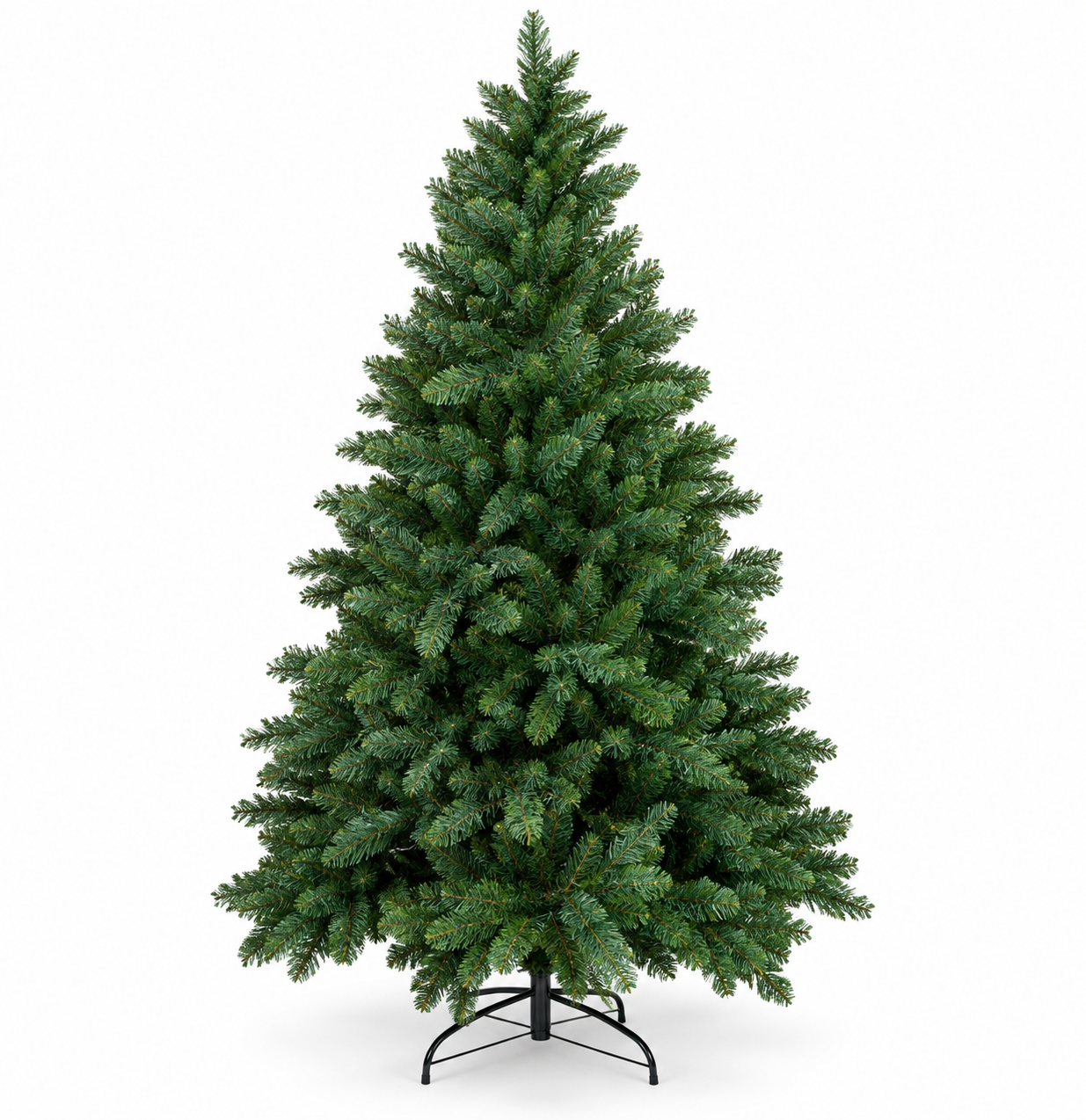



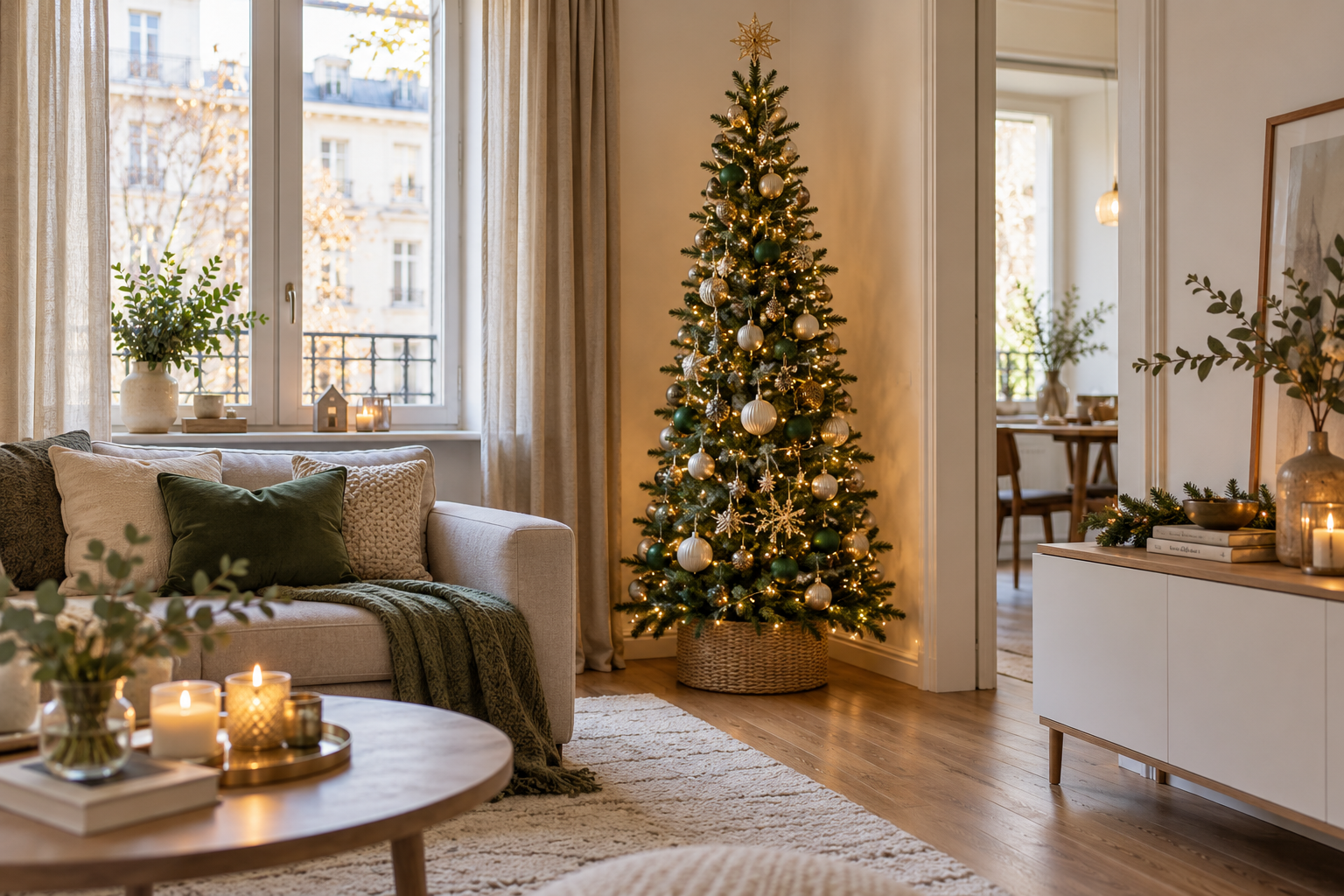
A compact interior does not mean giving up the Christmas tree. It does, however, require a more considered choice. Before selecting decorations, assess the tree’s actual footprint, the room’s circulation and the direction from which it will normally be viewed.
The aim is not to fit the largest possible tree into the room. It is to choose a shape that creates atmosphere without making the space uncomfortable.
Begin with the usable space
Clear the proposed position temporarily and measure:
- available width;
- usable depth;
- floor-to-ceiling height;
- distance from doors, windows and furniture;
- the space required for comfortable movement;
- the position of the electrical outlet, if lights will be used.
Do not consider only the dimensions stated for the tree. Allow for the stand, projecting ornaments and any gifts or decorations placed around the base.
A practical test is to mark the expected footprint on the floor with removable tape. Check whether doors, drawers and seating can still be used normally.
Choosing the right shape
Slim or narrow tree
A slim profile retains the vertical presence of a traditional tree while reducing the required floor depth.
It can work particularly well in:
- apartments;
- entrance areas;
- spaces between furniture;
- living-room corners;
- small offices and commercial interiors.
Its vertical shape can be enhanced with upward movement, lights placed deeper between the branches and decorations proportioned to the structure.
Among the available options, consider the 150 cm White Conical Tree with 1500 microLEDs or the champagne version, two vertical designs that are 150 cm tall and already illuminated.
Tree with one visible side
When the tree is placed against a wall, every side does not need the same decorative intensity.
Lights, botanical branches and ornaments can be concentrated on the front. The back can remain lighter and serve mainly to support the structure.
The base must remain stable, and the tree should not depend on leaning against the wall.
Tabletop or raised tree
A compact tree can be placed on a console, low cabinet or another stable support. Raising it creates a stronger visual presence without using much floor space.
Check that:
- the furniture can support the composition securely;
- the tree stand does not project beyond the surface;
- cables and decorations remain away from the edge;
- the furniture does not need to be opened or moved frequently.
Wall-based alternative
If the floor must remain completely clear, create a vertical composition using garlands, branches, lights or decorations arranged in a triangular outline.
This does not have to imitate a traditional tree exactly. It is a separate solution for corridors, small entrances and rooms where circulation is the priority.
Height and proportion
Height should never be considered in isolation. A tall, narrow tree may require less floor space than a shorter, wider design.
Include the following in the total measurement:
- the stand;
- any pot or base cover;
- the tree topper;
- upper branches;
- clearance below the ceiling.
Leaving visible space above the tree prevents the composition from appearing compressed. If the topper is an important part of the design, include it in the calculation from the beginning.
Where to position the tree
A good position should be visible without interrupting everyday activities.
Avoid placing the tree:
- in front of a door or exit;
- in a narrow route through the room;
- where it prevents furniture or windows from opening;
- near flames, candles or heat sources;
- where cables cross a walking route;
- on an unstable surface.
For safety, never block an exit and always follow the manufacturer’s instructions when connecting decorative lights.
How to decorate a small tree
Choose a visual direction
Each element carries more weight on a compact tree. Select one main direction:
- vertical, to emphasise height;
- diagonal, to introduce movement;
- grouped, to create focal points and leave lighter areas.
A perfectly uniform arrangement can make the tree look rigid and overcrowded.
Limit the palette
One dominant colour, one supporting tone and a controlled accent will usually be sufficient.
Use the guide to Christmas Colours 2026 to coordinate the palette and materials.
Work in layers
- open and shape the branches;
- install and check the lights;
- add structural elements;
- position medium-sized decorations;
- complete the design with a limited number of small details;
- inspect the tree from the normal circulation route.
Lights should be undamaged and suitable for their intended use. Inspect cables and connections and follow the manufacturer’s instructions before installation.
Use focal points carefully
A small tree does not necessarily require only tiny decorations. One or two larger elements can create depth when they are proportionate and secured to stable parts of the structure.
For larger focal decorations, see the guide to oversized velvet baubles.
Making the composition feel larger
- Repeat the same colour in separated areas.
- Place some lights deeper between the branches.
- Combine matte and gently reflective surfaces.
- Leave selected areas visually open.
- Coordinate one nearby detail, such as a garland or table arrangement.
- Avoid filling the base when this reduces circulation.
This makes the tree feel connected to the room rather than forced into an available corner.
When there is no room for a tree
A festive atmosphere can also be created with:
- a vertical garland;
- a group of decorated branches;
- a raised miniature tree;
- suspended ornaments;
- a wall-mounted light composition;
- coordinated details across the entrance, table and window.
For a scheme beyond the traditional tree, read Alternative Christmas 2026.
Mistakes to avoid
- choosing the tree without measuring its base;
- considering height but not depth;
- obstructing doors or circulation;
- using too many decorations with equal visual importance;
- completely hiding the branches;
- leaving cables across walking routes;
- using an unstable support;
- filling every nearby surface with additional Christmas elements.
Checklist before choosing
- Have I measured the width, depth and height?
- Have I checked doors, drawers and circulation?
- Have I included the stand and topper?
- Will one side or several sides be visible?
- Can the electrical outlet be reached without crossing a walkway?
- Can the structure be secured?
- Have I limited the palette?
- Can the room still be used comfortably?
Frequently asked questions
Is a short tree or a slim tree better?
It depends on the room. A slim tree uses vertical space and limits its width, while a shorter tree may fit better beneath windows, shelves or architectural features.
Can I place the tree behind a door?
Avoid this when the door could strike the tree or when the position reduces the width of the route.
How do I decorate only the visible side?
Concentrate lights and ornaments on the front, while retaining enough weight and branch structure at the back to keep the tree stable.
Can I use large decorations?
Yes, in limited numbers. They should act as focal points without affecting balance, stability or circulation.
For the home: explore the MyFlower Christmas selection, beginning with the available space.
For shops, hotels, restaurants and events: My Flower Pro can develop a display around the venue, circulation and visual identity.